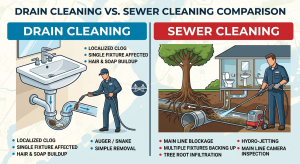
Drain cleaning removes a blockage from a single branch pipe inside your home- one sink, shower, tub, or toilet at a time. Sewer cleaning clears the main lateral pipe running underground from your home’s foundation to the city sewer in the street, affecting your entire plumbing system at once. Here is the fastest way to know Drain Cleaning vs. Sewer Cleaning whice one you need:
- One fixture slow or clogged, rest of house fine? → You need drain cleaning.
- Multiple fixtures backing up at the same time? → You need sewer cleaning.
- Not sure? → Start with a camera inspection before spending money on either.
In Staten Island, getting this diagnosis right matters more than most places- aging clay pipes, mature tree roots, and NYC’s combined sewer system make misdiagnosis both common and expensive.
You Called a Drain Cleaner- But Is That Actually What Your Home Needs?
Picture this: your kitchen sink starts draining slowly on a Wednesday morning. You call a local plumber, they run a snake, charge for the visit, and water flows again. You consider the problem solved.
Three weeks later, your basement floor drain backs up with sewage while your washing machine is mid-cycle. Your shower gurgles. The downstairs toilet will not flush. The original problem was never a kitchen sink clog- it was the main sewer line. The snake punched a temporary hole through a root mass that has been growing for years.
Why This Mistake Is So Common- and So Costly
Here is what typically happens when Staten Island homeowners get the diagnosis wrong:
- A drain cleaning company is called for a slow drain and runs a snake through the main sewer cleanout.
- The clog clears temporarily- relief lasts 2 to 4 weeks before the backup returns.
- The homeowner calls again- the same fix is applied, and the cycle repeats.
- The root mass grows thicker over months of untreated intrusion, putting stress on the pipe.
- The pipe eventually cracks or collapses- turning a $450 hydro jetting job into a $15,000 lateral replacement.
This guide explains the full difference between drain cleaning and sewer cleaning in Staten Island, how to know which one your home needs right now, and why local factors- older pipes, mature trees, combined sewers- make this distinction more critical here than anywhere else in New York City.
What Is Drain Cleaning? – Definition, Causes, and Methods
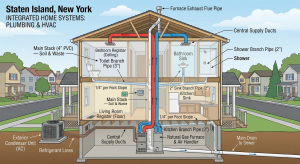
Drain cleaning is the removal of a blockage from a single branch pipe inside your home. It targets the smaller pipes- typically 1.5 to 3 inches in diameter– that connect individual fixtures to the main plumbing stack. When one of these is blocked, only that fixture is affected. Everything else in the house works normally.
Which Fixtures Does Drain Cleaning Cover?
- Kitchen sinks- grease, food debris, and soap buildup.
- Bathroom sinks- hair, toothpaste, and soap scum.
- Showers and bathtubs- hair and soap accumulation.
- Toilets- paper buildup, foreign objects, partial blockages.
- Laundry drains- lint and detergent residue.
What Causes Drain Clogs in Staten Island Homes?
The most common causes, in order of frequency in Staten Island residential properties:
- Hair and soap scum- The leading cause of bathroom sink and shower drain clogs. Combined into a sticky mass that slowly restricts water flow.
- Cooking grease and oil- Cools and solidifies inside branch pipes. In older Staten Island cast iron kitchen lines, grease deposits build up for decades before causing a full blockage.
- Food particles and debris- Accumulate inside branch pipes around the P-trap, even with a garbage disposal installed.
- Soap and toothpaste buildup- Bar soap contains fats that harden and bond with NYC’s hard water mineral deposits inside bathroom sink lines.
- Flushed non-flushable- Cotton pads, wet wipes, and dental floss that partially travel through branch pipes before forming a blockage.
How Is Professional Drain Cleaning Done?
A licensed technician uses one of the following methods based on the clog’s depth and type:
- Hand snake (manual auger): Simple clogs at or near the P-trap beneath the fixture. Takes 15 to 30 minutes.
- Electric drum auger: Motorized snake with 25 to 50 feet of reach for deeper branch line blockages inside walls and floors.
- Bio-enzyme drain treatment: Liquid enzyme solution dissolves organic buildup over several days. Used as a preventive maintenance tool, not for active clogs.
- Hydro jetting (branch line): High-pressure water for branch lines with heavy grease or soap scale. Less common than for main lines but effective on older cast iron fixtures.
Typical drain cleaning service in Staten Island takes 30 to 60 minutes. It is a targeted, one-pipe fix- not a whole-system intervention.
Drain Cleaning- Key Facts at a Glance
- Pipe size treated: 5 to 3 inches in diameter.
- Fixtures affected: One fixture only- rest of home works normally.
- Typical job time: 30 to 60 minutes.
- Cost range: $100 to $300 per fixture.
- Results last: 6 months to 2 years depending on household habits.
- NYC permit required:
What Is Sewer Cleaning? – Definition, Causes, and Methods
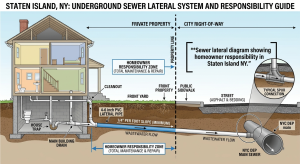
Sewer cleaning clears the main sewer lateral- the underground pipe, typically 4 to 6 inches in diameter, that carries all wastewater from your home to the city sewer main beneath the street. A blocked main lateral affects every drain in the house simultaneously. It is a completely different problem from a branch drain clog, requiring different equipment, different access, and a different level of urgency.
The NYC DEP Ownership Boundary- What Homeowners Must Know
The NYC Department of Environmental Protection (DEP) is clear on this: property owners are fully responsible for the private sewer lateral from the home’s foundation to the point it connects with the city sewer main in the street. This means:
- The city maintains the main sewer pipe under the street.
- You own and are responsible for everything between your foundation and that city connection.
- All cleaning, repair, and replacement costs are the homeowner’s financial and legal responsibility.
- Any repair or replacement of a private lateral requires an NYC DEP permit, filed by a licensed master plumber.
What Causes Main Sewer Line Blockages in Staten Island?
- Tree root intrusion- The U.S. Forest Service has established that tree roots cause over 50% of all residential sewer blockages. Roots enter aging clay or cast-iron pipes through cracks and joint separations, growing inward until they form a dense obstruction.
- Accumulated grease and mineral scale- Years of cooking grease and NYC’s hard water mineral deposits narrow the pipe interior until even minor debris causes a full blockage.
- Cracked or collapsed pipe- Clay tile and cast-iron laterals that are 50 to 80+ years old crack underground pressure and can collapse entirely.
- Pipe belly or sag- A low point in the underground pipe caused by soil settlement. Water and debris pool in the sag, creating recurring blockages that snaking cannot fix.
- Foreign object accumulation- non-flushable items that partially travel through branch lines and form an obstruction at bends or joints in the main lateral.
How Is Professional Sewer Cleaning Done?
A licensed sewer technician follows this sequence for effective main line clearing:
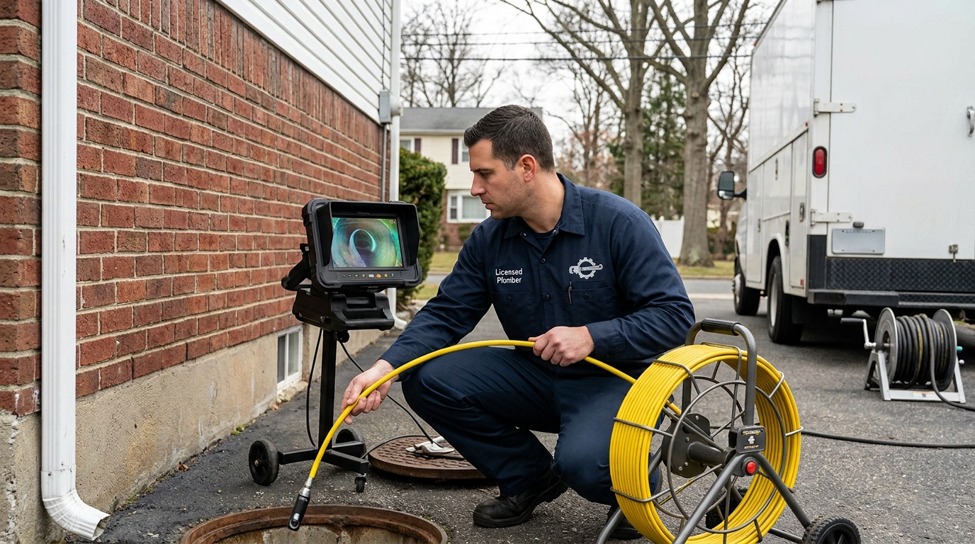
- Step 1- Video camera inspection: A waterproof camera is sent through the lateral to identify the exact cause and location of the blockage before any equipment is chosen. This step should not be skipped on homes over 30 years old.
- Step 2- Root cutting (if needed): A mechanical spinning blade severs established root masses that are too thick for a water jet to push through.
- Step 3- Hydro jetting (1,500–4,000 PSI): High-pressure water blasts the entire pipe interior clean, removing grease, scale, root hairs, and debris from wall to wall- not just punching a hole through the clog.
- Step 4- Post-clean camera verification: A second camera pass confirms the pipe is fully clear and shows the pipe’s structural condition for the homeowner’s records.
Learn more about what professional sewer cleaning in Staten Island involves, including what to expect from a hydro jetting service and camera inspection visit.
Sewer Cleaning- Key Facts at a Glance
- Pipe size treated: 4 to 6 inches in diameter (main lateral).
- Fixtures affected: All fixtures in the home simultaneously.
- Typical job time: 1 to 4 hours depending on blockage severity.
- Best tool: Hydro jetter (1,500–4,000 PSI) + video camera inspection.
- Cost range: $350 to $600+ for hydro jetting; $150–$350 for camera inspection.
- Results last: 2 to 3 years with professional hydro jetting.
NYC DEP permit: Required for any lateral repair or replacement.
Drain Cleaning vs. Sewer Cleaning in Staten Island: Full Comparison Table
Use this table to understand the complete difference between drain cleaning and sewer cleaning before deciding which service your home needs:
| Factor | Drain Cleaning | Sewer Cleaning (Main Line) |
| What It Clears | Single branch pipe inside the home | Main underground lateral- foundation to city street |
| Pipe Diameter | 1.5 to 3 inches | 4 to 6 inches |
| Common Causes | Hair, grease, soap scum, food debris | Tree roots, sediment, collapsed pipe, mineral scale |
| Fixtures Affected | One fixture- all others work normally | All fixtures in the home at the same time |
| Tools Used | Hand snake, electric auger, bio-enzyme | Hydro jetter (1,500–4,000 PSI), camera, root cutter |
| Typical Job Time | 30 to 60 minutes | 1 to 4 hours |
| Urgency Level | Moderate- can wait 1 to 2 days | High- escalates to sewage backup fast |
| Results Last | 6 months to 2 years | 2 to 3 years with hydro jetting |
| NYC DEP Permit | Not required | Required for lateral repair or replacement |
| Typical Cost (2026) | $100–$300 per fixture | $350–$600+ for hydro jetting the main line |
The single most important rule: if more than one fixture is backing up or draining slowly at the same time, you do not have a drain clog. You have a main sewer line problem. Drain cleaning will not fix it- no matter how many times a snake is run through it.
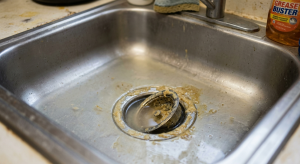
5 Signs You Need Drain Cleaning- Not Sewer Cleaning
You need drain cleaning when only one fixture is affected while everything else in the house works normally. These are the specific signs to identify:
Sign 1- Only One Fixture Is Slow or Clogged
How to confirm this is a drain issue, not a sewer issue:
- Your kitchen sink drains slowly, but the shower, toilet, and bathroom sink all work fine.
- Water backs up in the bathtub but drains eventually within a few minutes.
- A single bathroom sink smells or drains slowly while everything else in the house is normal.
Common in: 1950s and 1960s Staten Island ranch homes and row houses with cast iron branch lines coated in accumulated grease.
Sign 2- A Single Drain Produces an Odor but Still Drains
The odor source tells you a lot:
- Smell from one fixture only: Buildup in the P-trap or branch line- a drain cleaning issue.
- Smell from multiple fixtures or the basement: Sewer gas from the main lateral- a sewer cleaning issue.
- Smell after running water in a rarely used drain: Dry P-trap- pour a cup of water down it to reseal the trap.
Sign 3- Water Pools in One Fixture Then Slowly Clears
What this pattern tells you:
- Water pooling and clearing within 2 to 5 minutes = partial branch blockage, not a main line issue.
- A plunger clears it temporarily = the clog is near the fixture, within plunger range.
- Plunger gives only 2 to 3 days of relief = the clog is deeper in the branch line- professional drain cleaning needed.
Sign 4- The Problem Appeared After Heavy Use
Usage patterns that suggest a branch clog:
- Kitchen sink acting up after a holiday cooking session or large meal preparation.
- Bathroom drain slow after extended houseguest stay.
- Toilet clogging more frequently during high-occupancy periods.
These situations almost always resolve with a single targeted drain cleaning visit.
Sign 5- Plunging Provides Temporary but Real Relief
What the plunger response tells you:
- Plunging clears it and it stays clear for weeks or months: Branch drain clog, resolved.
- Plunging clears it but returns in days: Deeper branch blockage- needs professional drain cleaning.
- Plunging has zero effect and backup worsens: Main sewer line problem- stop plunging and call for sewer service.
Quick Self-Diagnosis Test
Run water in two or three fixtures simultaneously. Turn on the kitchen sink, a bathroom faucet, and flush a toilet at the same time.
- Only one backs up while others drain normally: You need drain cleaning.
- Two or more back up or gurgle together: Stop using water. You need sewer cleaning immediately.
- Unsure of the result: A camera inspection removes all guesswork in under an hour.
Book a same-day drain cleaning inspection in Staten Island – available 24/7.
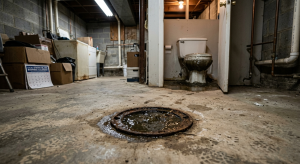
6 Warning Signs You Need Sewer Cleaning in Staten Island
You need sewer cleaning when multiple fixtures are involved simultaneously, or when symptoms point to a problem underground rather than inside your walls. These signs are more serious and should not be ignored.
Warning Sign 1- Multiple Fixtures Backing Up at the Same Time
This is the most definitive sign of a main sewer line blockage. Look for:
- Toilet backs up while the washing machine finishes a cycle.
- Shower starts filling at the same moment as the basement floor drain.
- Kitchen sink and bathroom sink both drain slowly at the same time.
- Running water anywhere in the house causes a backup somewhere else.
If two or more fixtures are involved, stop using water in the house and call for sewer cleaning. Continued use forces sewage back through the lowest drains.
Warning Sign 2- Gurgling Sounds from Drains or Toilets
Gurgling is trapped sewer gas finding the path of least resistance. Here is what each pattern means:
- Toilet gurgles when washing machine drains: Main sewer line partially blocked.
- Floor drain gurgles when you take a shower: Main lateral obstruction.
- Multiple drains gurgle at the same time: Main sewer line critically blocked- urgent service needed.
Common location in Staten Island: Basement apartments in New Dorp, Eltingville, and Bay Terrace- gurgling in the basement bathroom is often the first warning before a full sewage backup.
Warning Sign 3- Sewage Smell from Basement or Yard
The location of the odor tells you what is happening:
- Basement floor drain: Main lateral partially blocked; sewer gas pushing back into the home.
- Basement bathroom or laundry area: Main line obstruction forcing gas through lowest fixture traps.
- Front or side yard: Cracked or separated underground pipe allowing sewage to escape into soil.
Any yard odor combined with soft, wet ground is a critical warning sign. A camera inspection can locate the damage without excavation.
Warning Sign 4- Wet or Lush Yard Patches Without Recent Rain
What the yard is telling you:
- A noticeably soft or wet patch above the path of the underground lateral is a sign of a cracked or separated pipe.
- Unusually lush, green grass in a narrow strip from foundation to street- sewage is fertilizing the soil above a leak.
- Ground depressions or sinking soil along the lateral path- possible pipe collapse underneath.
Because Staten Island homeowners own the lateral from foundation to street, all repair costs are theirs. Early detection via camera saves tens of thousands in excavation costs.
Warning Sign 5- A Prior Snake Job Only Lasted Weeks
The pattern of recurring failure tells you exactly what happened:
- Snake was run → backup cleared → returned within 2 to 4 weeks.
- This cycle repeated two or more times with the same temporary relief period.
- Root mass: snake punched a hole through it but did not remove it- roots regrew around the opening.
- Grease buildup: snake moved debris temporarily but left the coating on pipe walls, which reformed.
The correct fix is hydro jetting with camera inspection- not another snake. Snaking a root intrusion problem is like trimming a weed without pulling the root.
Warning Sign 6- Backups Worsen After Heavy Rain
This is a Staten Island-specific pattern caused by the NYC combined sewer system. Here is what is happening:
- Heavy rain overwhelms the city’s combined stormwater and sewage pipes.
- Excess pressure reverses direction and pushes back through private sewer laterals.
- The backup appears in the lowest drains- typically basement floor drains- without any household clog present.
- No snake treatment will prevent this from recurring in the next heavy rain.
The NYC DEP confirms approximately 60% of New York City operates on this combined sewer system. North Shore neighborhoods- Stapleton, Tompkinsville, Port Richmond, West Brighton- are most affected. For properties in these areas, the solution combines sewer cleaning with a backflow prevention valve consultation with a licensed local plumber.
The Misdiagnosis Warning: What Getting This Wrong Costs You
Here is the real cost of calling a drain cleaner when the problem is in the main sewer line:
- Snake visit #1: $150–$300. Provides 2 to 4 weeks of relief.
- Repeat snake visits over 12 months: $900–$1,800 spent on temporary fixes.
- Root mass grows thicker and puts increasing pressure on aging clay or cast iron pipe.
- Correct fix- hydro jetting + camera: $450–$750. Resolves the problem in one visit.
- Untreated result- pipe cracks or collapses: $10,000–$25,000+ for full lateral excavation and replacement.
A camera inspection that prevents the replacement costs under $300. The math is straightforward.
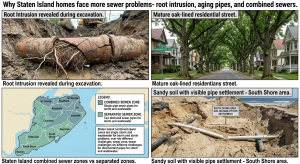
5 Reasons Why Staten Island Has More Sewer Problems Than Other Boroughs
These five local factors combine to make sewer problems more frequent, more severe, and faster to escalate in Staten Island than elsewhere in New York City. Understanding them changes how you respond when something goes wrong with your plumbing.
Factor 1- Aging Housing Stock and Original Pipe Materials
What the data shows about Staten Island’s residential infrastructure:
- Median construction year for Staten Island homes: 1973 (U.S. Census Bureau data).
- Approximately 5% of homes were built before 1940– with sewer laterals now 80+ years old.
- Homes built before 1980 were almost universally plumbed with clay tile or cast iron laterals– materials that crack, shift at joints, and invite root intrusion far more than modern PVC.
- The Center for an Urban Future reports the average age of NYC’s sewage infrastructure is approximately 84 years, with nearly 4,000 miles of vitreous clay pipe still in service.
What this means for you: If your Staten Island home was built before 1980, your sewer lateral is almost certainly original material and may already have the joint separations that invite root intrusion.
Factor 2- The Greenest Borough Has the Worst Root Problem
Key facts about Staten Island’s tree canopy and root intrusion risk:
- Staten Island is the most forested of New York City’s five boroughs.
- Residential streets are lined with mature oak, sycamore, silver maple, and elm trees- many 40 to 70 years old.
- Root systems from these trees extend 30 to 50 feet in every direction from the trunk.
- The U.S. Forest Service found that tree roots cause more than 50% of all residential sewer blockages
- Species with the most aggressive root behavior- silver maple, white ash, willow- are common throughout Staten Island neighborhoods.
What this means for you: If your home has mature street trees within 30 feet of the sewer lateral path, root intrusion should be treated as an annual maintenance priority, not an occasional emergency.
Factor 3- The Combined Sewer System Creates Rain-Triggered Backups
How New York City’s combined sewer system affects Staten Island homeowners specifically:
- Approximately 60% of New York City operates on a combined sewer system where stormwater and household sewage travel in the same pipe (NYC DEP).
- North Shore neighborhoods- Stapleton, Tompkinsville, West Brighton, Port Richmond, St. George- are primarily on the combined system.
- During heavy rain, the city’s combined pipes reach capacity, and excess pressure reverses into private laterals.
- Result: basement floor drain backups that look exactly like a sewer clog but are caused by city backpressure, not a household blockage.
- No snake treatment prevents this from recurring- a backflow prevention valve is the structural fix.
What this means for you: If your basement backs up only during or after heavy rain, this is not a simple drain cleaning problem. A licensed plumber familiar with Staten Island’s sewer zones can advise on the correct combination of sewer cleaning and backflow protection.
Factor 4- South Shore Soil Causes Underground Pipe Settlement
Why South Shore properties face a unique sewer risk:
- South Shore neighborhoods- Tottenville, Great Kills, Annadale, Huguenot, Prince’s Bay- were developed partly on reclaimed wetland and sandy fill soil.
- This soil type compresses and shifts over time, causing underground pipes to develop low points called pipe bellies or sags.
- Water, grease, and debris pool in the sag and create recurring blockages that snaking temporarily clears but cannot permanently fix.
- Video camera inspection is the only way to identify a pipe belly without excavation.
- Long-term solution: pipe relining or replacement of the sagging section.
What this means for you: South Shore homeowners with unexplained recurring main line backups should request a camera inspection as the first diagnostic step- snaking alone will not reveal or fix a pipe belly.
Factor 5- NYC Hard Water Accelerates Mineral Buildup in Aging Pipes
How hard water affects Staten Island’s older pipe systems:
- NYC water supply carries dissolved minerals (calcium carbonate, magnesium) that deposit on pipe walls over years of use.
- In a 50-year-old cast iron or clay lateral, these deposits can meaningfully reduce the effective interior diameter.
- A narrowed pipe needs only a small root intrusion or grease coating to block completely.
- Regular hydro jetting removes mineral scale alongside organic debris, which is why results last significantly longer than snaking in older systems.
What this means for you: In an older Staten Island home, hydro jetting addresses four problems at once- root hairs, grease, mineral scale, and general debris- in a single visit.
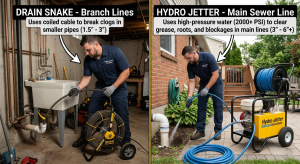
The Tools Used for Drain Cleaning vs. Sewer Cleaning- and Why It Matters
Understanding the equipment used for each service helps you ask the right questions before approving any work. The wrong tool for the job does not just waste money- it masks a serious condition while the real problem continues underground.
| Tool | Used For | Service Type | How Long Results Last |
| Hand snake | P-trap and near-fixture clogs | Drain cleaning | 6 to 12 months |
| Electric drum auger | Branch line clogs up to 50 feet | Drain cleaning | 6 months to 2 years |
| Bio-enzyme treatment | Preventive organic buildup removal | Drain maintenance | Ongoing monthly use |
| Plunger | Minor near-fixture partial clogs | First-response only | Days to weeks |
| Motorized sewer auger | Soft main line blockage (short-term) | Sewer cleaning | 3 to 6 months |
| Hydro jetter (1,500–4,000 PSI) | Full wall-to-wall main line cleaning | Sewer cleaning | 2 to 3 years |
| Video camera inspection | Diagnosis- root, grease, belly, crack | Sewer + drain diagnostic | N/A- one-time diagnostic |
| Root-cutting attachment | Severing thick root masses | Sewer cleaning pre-treatment | Used before jetting |
The Hydro Jetter vs. Snake Decision- The Most Important Choice
Here is when each tool is the right choice:
When a Motorized Snake Is Appropriate:
- A main line backup that has never occurred before.
- A relatively young pipe (post-1990 PVC) with a first-time soft blockage.
- A clog that is confirmed by camera inspection to be loose debris, not roots or heavy grease.
When Hydro Jetting Is the Correct Choice:
- Any main line problem with a history of recurrence after prior snaking.
- Camera inspection shows root intrusion, heavy grease coating, or mineral scale on pipe walls.
- Pre-1980 Staten Island home with original clay or cast-iron lateral.
- You want results that last 2 to 3 years rather than 3 to 6 months.
- Preventive maintenance visit- hydro jetting clean pipe is significantly more effective than snaking clean pipe.
3 Questions to Ask Before Approving Any Sewer Service
Ask these before any technician starts work:
- “Will you camera inspect before starting, or are you beginning without seeing what’s inside?” Camera inspection before treatment is standard on any main line service for a home over 30 years old.
- “Are you using a hydro jet or a mechanical snake for the main line?” For any recurring clog, root history, or pipe older than 1980, snaking alone is a temporary fix, not a solution.
- “Can you tell me what is causing the blockage before any work begins?” A professional who has inspected the pipe can answer this. One who has not should not be guessing.
Schedule an inspection-first sewer service in Staten Island– no guesswork, no hidden charges.
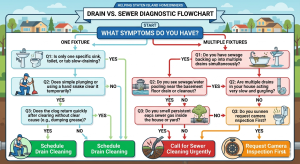
Which Service Do You Need Right Now? – The Complete Diagnostic Reference
Match your situation to the table below to determine the right next step before you make a call:
| Your Situation | What It Tells You | Right Service | Urgency |
| One fixture drains slowly | Branch line clog inside the home | Drain cleaning | Low- can wait 1 to 2 days |
| Multiple fixtures backing up | Main sewer line blocked underground | Sewer cleaning | High- call today |
| Clog after heavy use (guests/holiday) | Short-term branch line clog | Drain cleaning | Low- schedule soon |
| Snake done- clog returned in weeks | Root or grease not fully cleared | Hydro jet + camera | Medium- do not delay |
| Other drains gurgle when toilet flushes | Main sewer line partially blocked | Sewer cleaning | High- call today |
| Sewage smell from basement or yard | Cracked or blocked lateral underground | Camera inspection first | Urgent- call now |
| Backups only after heavy rain | NYC combined sewer backpressure | Sewer + backflow consult | Medium- schedule soon |
| One slow drain, everything else normal | Minor branch line buildup | Drain cleaning | Low- not an emergency |
For any symptom marked Urgent or High, contact a licensed sewer cleaning service in Staten Island before running any more water through the system.
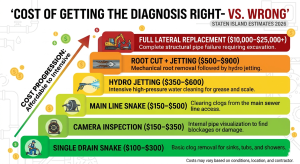
Drain Cleaning vs. Sewer Cleaning Costs in Staten Island- 2026 Pricing Guide
The figures below reflect the current general market range for Staten Island and the broader NYC area. Always request a written estimate before any work is approved.
Drain Cleaning- Typical Cost Range
- Single fixture drain cleaning (snake): $100 to $275.
- Toilet drain cleaning: $125 to $300 depending on access and blockage depth.
- Bio-enzyme preventive treatment: $50 to $150 for professional application; home kits available for ongoing monthly use.
- What increases the cost: Older pipe requiring careful technique, difficult access, or a compacted clog requiring extended clearing time.
Sewer Cleaning- Typical Cost Range
- Main sewer line snake (auger only): $150 to $500. Creates a temporary path but does not clean pipe walls.
- Main sewer line hydro jetting: $350 to $600 for standard residential service. Severe root intrusion or long lateral runs may cost more.
- Video camera inspection (standalone): $150 to $350. Many contractors bundle this with cleaning at a reduced combined rate.
- Root cutting combined with hydro jetting: $500 to $900+ depending on root severity and lateral length.
- Full sewer lateral replacement: $10,000 to $25,000 or more. Requires excavating driveways, city sidewalks, or landscaping.
The True Cost Comparison- Maintenance vs. Emergency
Here is what the numbers look like over time when the correct service is chosen vs. when it is not:
| Approach | Year 1 Cost | Year 3 Cost | Year 5 Cost | Total Risk |
| Snake-only (repeated visits) | $300–$600 | $600–$1,200 | $900–$1,800 | Pipe damage accumulates- lateral replacement likely |
| Hydro jetting + camera (correct fix) | $600–$950 | $600–$950 | $600–$950 | Pipe monitored- early damage caught before it escalates |
| Ignored entirely (no maintenance) | $0 | $0 | $10,000–$25,000+ | Full lateral replacement + excavation costs |
NYC DEP Permits- What Homeowners Must Know
When permits are required and why they protect you:
- Any repair or replacement of a private sewer lateral in Staten Island requires a permit from the NYC Department of Environmental Protection.
- Only a licensed master plumber can file for this permit- it cannot be done by an unlicensed contractor.
- Unpermitted lateral work creates homeowner liability and can complicate property sales.
- Always ask for proof of DEP registration before approving sewer lateral work. A licensed Staten Island plumbing service handles all permitting as part of the repair process.
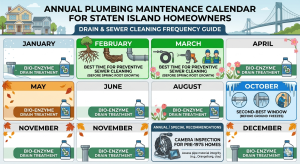
How Often Should Staten Island Homeowners Schedule Drain and Sewer Cleaning?
Preventive maintenance is the most cost-effective plumbing strategy for any home with aging infrastructure. These schedules are calibrated for Staten Island’s specific pipe materials, tree density, and soil conditions.
Drain Cleaning- Recommended Frequency
- Kitchen drains: Professional cleaning every 1 to 2 years for households with regular grease-heavy cooking.
- Bathroom drains: Professional cleaning every 2 years. Monthly bio-enzyme treatments maintain clear lines between visits.
- Floor drains and laundry lines: Annual inspection recommended, especially in older homes where these lines are rarely flushed and accumulate sediment quietly.
- After a drain cleaning: Run hot water for 2 to 3 minutes and apply an enzyme treatment monthly to maintain clear lines.
Sewer Cleaning- Recommended Frequency
- Homes with confirmed root intrusion: Every 12 to 18 months with hydro jetting. Annual root management costs far less than letting roots reach pipe-damaging thickness.
- Pre-1975 Staten Island homes: Annual video camera inspection strongly recommended. These homes are the most likely to have clay or cast iron laterals approaching end of service life.
- Homes with no known issues: Preventive sewer cleaning every 2 to 3 years keeps grease and sediment from accumulating.
- After any flood event or storm surge: Camera inspection before resuming normal use. Flood events shift pipe joints and introduce debris that accelerates future blockage.
- After purchasing an older Staten Island home: Camera inspection before moving in is strongly recommended. You need to know what is in those pipes before they become your emergency.
Staten Island Seasonal Maintenance Calendar
Best scheduling windows for Staten Island homeowners:
- February to March (Best window): Schedule preventive sewer cleaning before spring root growth surge begins. Root systems are dormant in winter- clearing them now prevents spring blockages.
- October (Second-best window): Post-leaf-drop, before the ground freezes. Good for both camera inspection and hydro jetting.
- Every month (ongoing): Pour a bio-enzyme drain treatment down kitchen and bathroom drains to prevent organic buildup between professional visits.
Schedule your seasonal sewer maintenance in Staten Island– same-day and next-day appointments available across all neighborhoods.
Why Local Knowledge Matters for Sewer and Drain Work in Staten Island
A technician without local experience in Staten Island may not know that a North Shore home from the 1940s is likely on the combined sewer system, that a South Shore property near the waterfront may have soil settlement issues creating a pipe belly under the front yard, or that a pre-1960 home in St. George almost certainly has a clay tile lateral with joint separations that already allow root access.
What Local Knowledge Covers That Generic Services Miss
- Knowing which specific neighborhoods- Stapleton, Port Richmond, West Brighton, Tompkinsville- are on the combined sewer system and which are on separate stormwater infrastructure.
- Understanding that pre-1975 clay and cast iron laterals require camera confirmation before hydro jetting pressure is selected.
- Recognizing that mature oak, sycamore, and silver maple trees on Staten Island streets create a root intrusion risk that requires annual proactive management, not reactive repairs.
- Understanding NYC DEP permitting requirements for lateral work and filing correctly on the homeowner’s behalf.
- Knowing South Shore soil conditions- reclaimed wetland, sandy fill- that create pipe belly risk in specific neighborhoods.
The Right First Step for Any Sewer or Drain Problem
No matter which symptom you are experiencing, the right sequence is:
- Identify whether it is one fixture or multiple fixtures. That single distinction tells you whether you need drain cleaning or sewer cleaning.
- For sewer symptoms- stop using water. Continued use forces sewage back through low drains and makes the problem worse.
- Request a camera inspection before any treatment is agreed upon. This confirms the exact cause and saves money by ensuring the right tool is applied for the right problem.
- Ask for a written estimate before work starts. A professional service provides this upfront, with no surprise charges after the job.
For homeowners across Staten Island- from St. George and Port Richmond on the North Shore to Great Kills, Tottenville, and Annadale on the South Shore- Plumbing Sewer & Drain Service offers 24/7 drain and sewer service with upfront pricing and an inspection-first approach. Call (718) 619-0807 or request a free estimate online.
Frequently Asked Questions
Is drain cleaning the same as sewer cleaning?
No. Drain cleaning clears a blockage from a single branch pipe serving one fixture inside your home. Sewer cleaning clears the main lateral pipe underground that connects your entire home’s plumbing to the city sewer system.
The key differences at a glance:
- Drain cleaning: One fixture. Inside the home. Pipe is 1.5 to 3 inches wide. $100–$300.
- Sewer cleaning: Entire home affected. Underground. Pipe is 4 to 6 inches wide. $350–$600+.
Calling one when you need the other is the most common reason homeowners pay for the same plumbing problem twice. Full details are available on our drain cleaning service page.
How do I know if I need my sewer line cleaned?
You likely need your sewer line cleaned if you notice any of the following:
- Multiple fixtures- toilets, sinks, showers, or floor drains- are backing up or draining slowly at the same time.
- Other drains in the house gurgle when you flush the toilet or run the washing machine.
- There is a sewage smell coming from basement floor drains or from the yard.
- A prior snake treatment gave only 2 to 4 weeks of relief before the problem returned.
- Backups or gurgling become noticeably worse after heavy rainfall.
If any of these apply, schedule a sewer inspection in Staten Island before the problem escalates.
What are the signs of a main sewer line clog?
The six most reliable signs of a main sewer line clog:
- Two or more fixtures back up or drain slowly at the same time.
- The toilet gurgles or bubbles when the washing machine finishes a cycle.
- Sewage backs up into the basement floor drain, bathtub, or shower.
- All drains throughout the house are slower than usual- not just one.
- A sewage odor is coming from the basement, bathroom floor drain, or the yard outside.
- The yard above the sewer lateral route is soft, wet, or unusually lush without recent rain.
Can drain cleaning fix a main sewer line problem?
No. Drain cleaning tools are designed for 1.5-to-3-inch branch pipes inside the home. A main sewer lateral is a 4-to-6-inch underground pipe that requires completely different equipment.
Why snaking a main sewer line does not fix a root or grease problem:
- A mechanical snake punches a hole through the blockage- it does not remove grease and root residue from the pipe walls.
- The debris reforms around the remaining material, usually within 2 to 6 weeks.
- Repeated snaking of an untreated root mass allows the roots to grow thicker each cycle.
- The correct solution for a main sewer line: video camera inspection followed by hydro jetting.
What is hydro jetting and when is it needed?
Hydro jetting uses high-pressure water at 1,500 to 4,000 PSI to scour the entire interior of a sewer pipe clean from wall to wall.
Hydro jetting is the appropriate choice when:
- The main sewer line has a history of recurring clogs after previous snaking.
- Camera inspection reveals root intrusion, heavy grease coating, or significant mineral scale.
- The home has a pre-1980 lateral with original clay or cast iron pipe.
- You want results that last 2 to 3 years rather than the 3 to 6 months typical of a snake job.
Learn more about hydro jetting for sewer cleaning in Staten Island– including what to expect during the service visit.
How often should sewer lines be cleaned in Staten Island?
The right schedule depends on your home’s history and pipe material:
- Known root intrusion: Every 12 to 18 months with hydro jetting.
- Pre-1975 home: Annual video camera inspection minimum.
- No known issues: Preventive sewer cleaning every 2 to 3 years.
- After a flood event: Camera inspection before resuming normal use.
A camera inspection gives you the clearest guidance on what your specific lateral needs- general schedules are starting points, not one-size-fits-all rules.
What causes main sewer line blockages in Staten Island specifically?
The leading causes in order of frequency for Staten Island residential properties:
- Tree root intrusion: Responsible for over 50% of sewer blockages nationally. In Staten Island, where mature oak and sycamore trees line most residential streets, this is the single most common cause of main line failure.
- Accumulated grease and mineral scale: Especially common in older cast iron and clay laterals that have been collecting deposits for 50+ years.
- Combined sewer backpressure: Affects North Shore neighborhoods on NYC’s combined stormwater and sewage system- creates rain-triggered backups with no household clog.
- Pipe belly or sag: Caused by soil settlement in South Shore areas developed on reclaimed wetland- creates low points where debris accumulates.
- Cracked or collapsed pipe: Clay tile and cast iron laterals crack underground pressure and root stress after 50 to 80+ years.
How much does sewer line cleaning cost in Staten Island?
Current pricing guide for Staten Island, 2026:
- Main sewer line snake: $150 to $500.
- Hydro jetting (main lateral): $350 to $600 for standard residential service.
- Video camera inspection: $150 to $350 standalone; often bundled with cleaning at a lower combined rate.
- Root cutting + hydro jetting: $500 to $900+.
- Full sewer lateral replacement: $10,000 to $25,000+, including excavation and restoration.
Request a free estimate for sewer cleaning in Staten Island– upfront pricing provided before any work begins.
Does the NYC DEP clean private sewer lines in Staten Island?
No. The NYC DEP maintains the city’s sewer main beneath the street. Your private sewer lateral– from your foundation to the city connection point- is entirely your responsibility as a property owner.
What this means in practice:
- All cleaning, maintenance, repair, and replacement costs for the private lateral are the homeowner’s expense.
- If the DEP investigates a backup complaint and determines the issue is in the private lateral, you receive a formal Notice to Repair.
- Any lateral repair or replacement requires an NYC DEP permit filed by a licensed master plumber.
Is a video camera inspection really necessary before sewer cleaning?
Yes- for any home over 30 years old, camera inspection before treatment is standard professional practice, not an optional extra.
What camera inspection confirms before any work begins:
- Whether the problem is root intrusion, grease buildup, a pipe belly, or structural damage.
- The exact location of the blockage within the lateral- no guesswork on length of pipe to treat.
- Whether the pipe can safely handle full hydro jetting pressure or needs a gentler approach.
- Baseline condition of the pipe for your homeowner records- useful for insurance and future maintenance planning.
Book a camera inspection for your Staten Island sewer line– same-day availability in most areas.
What should I do if my sewer backs up on a weekend or at night?
Follow these steps immediately:
- Stop using all water in the house. Do not flush toilets, run the dishwasher, or use the washing machine. Continued use forces sewage back through the lowest drains.
- Do not use chemical drain cleaners. These are ineffective on main sewer blockages and can damage aging pipe material.
- Call a 24-hour emergency sewer cleaning service. In Staten Island, licensed providers offer same-day emergency response with no overtime surcharges.
- Note which fixtures are affected. This information helps the technician assess severity over the phone before arriving.
- For 24/7 emergency sewer cleaning in Staten Island, call or submit a service request here– the team responds day and night, including weekends and holidays.
Final Takeaway: Getting the Diagnosis Right Protects Your Home and Your Budget
The difference between drain cleaning and sewer cleaning in Staten Island is not a technical detail for plumbers. It is the single most important question a homeowner should answer before spending money on any service call.
The Core Difference- Three Sentences
- Drain cleaning clears one branch pipe inside your home. One fixture. Under an hour. $100 to $300.
- Sewer cleaning clears the main underground lateral connecting your entire home to the city sewer. All fixtures affected. Requires hydro jetting. $350 to $600+.
- Getting it wrong means paying for temporary relief on a permanent problem- while the real issue continues underground until it becomes a $10,000+ repair.
What to Do Right Now
Based on what you have read, here is your next step:
- One fixture slow, rest of house normal: Book a drain cleaning service– targeted, fast, and affordable.
- Multiple fixtures affected, gurgling, or sewage smell: Schedule a sewer cleaning inspection– start with camera, then clean.
- Not sure which applies to you: Request a free estimate and inspection– an experienced technician will tell you exactly which service you need before any work starts.
- Pre-1975 Staten Island home with no recent maintenance: An annual camera inspection is strongly recommended. Know what is in your pipes before it becomes an emergency.
For Staten Island homeowners from St. George to Tottenville, Plumbing Sewer & Drain Service is available 24 hours a day, 7 days a week. Call (718) 619-0807 or submit a service request online. No guesswork. Upfront pricing. The right fix, the first time.