To choose a reliable plumber in Staten Island, NY, verify their NYC Master Plumber license through the Department of Buildings’ BIS lookup tool, request a Certificate of Insurance naming you as the certificate holder, check hyperlocal review sources such as Facebook community groups and NextDoor, compare two to three itemized quotes, and confirm the plumber has real experience with Staten Island’s older housing stock, private septic systems, and flood-prone areas. A licensed local plumber typically charges between $150 and $250 per hour, with most standard repair calls falling between $200 and $530, depending on the time of day and the scope of the work.
Introduction
Staten Island homeowners run into a very specific kind of frustration when they need a plumber. You search “plumber near me.” A dozen names show up. Half of them have five-star reviews that feel suspiciously uniform. And you have no real way to tell who actually knows what they are doing versus who simply paid for good marketing.
This gets more complicated once you factor in what makes Staten Island different from the rest of New York City:
- Homes built decades before modern plumbing codes existed.
- Neighborhoods still running on private septic systems instead of city sewer lines.
- Hilly terrain that changes how water drains around a foundation.
- Coastal flood zones that demand specific fixture and valve knowledge.
The generic “check reviews and get a quote” advice found on most sites simply does not account for any of this. This guide breaks down how to choose a reliable plumber in Staten Island, NY, step by step, using the exact tools New York City gives homeowners to verify who is licensed, insured, and genuinely worth trusting with their home. Whether you are dealing with a clogged drain right now or planning ahead before a real emergency hits, the process below applies the same way.
Why Staten Island Plumbing Isn’t Quite Like the Other Boroughs
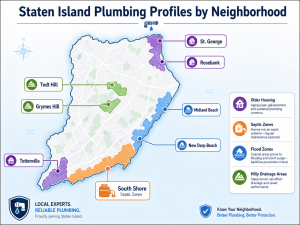
A plumber who does great work in a newer Brooklyn condo building is not automatically the right fit for a 1920s house in Rosebank. Staten Island has several characteristics that change what “reliable” really means here, and understanding them will help you ask better questions when you call around.
1. Older Housing Stock With Older Pipes
Large parts of St. George, Tottenville, and Rosebank were built long before modern plumbing codes existed. This creates a few recurring issues:
- Many homes still have galvanized steel or cast iron piping somewhere in the system, which behaves very differently from the copper or PEX piping used in newer construction.
- Corrosion inside old pipes gradually narrows the interior diameter, which can cause reduced water pressure that feels like a fixture problem but is actually a pipe-age problem.
- Pipe joints and fittings in older homes sometimes do not match anything in a modern parts catalog, which means a plumber unfamiliar with older systems may need extra time (and extra cost) sourcing the right part.
- Renovation work in these homes often uncovers plumbing that was never properly updated during earlier remodels, adding surprises mid-project.
2. Private Septic Systems on the South Shore
This detail is missing from almost every other guide on this topic, yet it matters a great deal for a meaningful share of Staten Island homeowners.
- Unlike most of New York City, Staten Island still has pockets, particularly on the South Shore in areas like Annadale, Rossville, and parts of Tottenville, where homes were built before the sewer network reached them.
- Many of these properties still rely on private septic systems or cesspools instead of the municipal sewer line.
- If your home falls into this category, you need a plumber who is genuinely comfortable with septic and sewer cleaning work, not just standard fixture repairs.
- Any septic system repair legally requires a permit through the local health department, so ask directly whether the plumber has pulled septic permits before.
3. Hilly Terrain Changes Drainage Behavior
Neighborhoods like Todt Hill and Grymes Hill sit on some of the highest natural elevation in New York City.
- Elevation changes affect how water moves around a foundation and through a yard.
- Homes on sloped lots are more prone to basement water intrusion if grading and drainage were not done correctly.
- Sump pumps and proper exterior drainage come up more often in service calls here than in flatter parts of the city.
4. Flood Zones Along the Shoreline
Areas like Midland Beach, New Dorp Beach, and parts of the East Shore took serious damage during Hurricane Sandy, and FEMA flood maps still classify large sections of the coastline as high-risk.
- A plumber working in these areas should understand backflow prevention valves.
- Flood-resistant fixture installation is a specific skill set, not something every general plumber has practiced regularly.
- Homeowners in these zones should ask directly whether the plumber has handled backflow prevention or flood-valve installations before, rather than assuming standard experience covers it.
None of this means you need to interrogate every plumber about hydrogeology before letting them into your basement. It simply means that “are they licensed and do they have good reviews” is not quite enough on its own here.
Step 1: Confirm the License Is Actually Real
Anyone can put “licensed and insured” on a van. New York City gives homeowners a free way to check whether that claim is true, and skipping this step is the single most common mistake homeowners make.
In New York City, plumbing work legally requires a Master Plumber license issued by the Department of Buildings. A few key facts about how this licensing system works:
- A Master Plumber has passed both a written and a practical exam.
- They have completed a background investigation before being licensed.
- They are the only professional legally allowed to pull permits and run a plumbing business independently.
- Anyone working under them, such as a journeyman plumber or an apprentice, may perform plumbing work only under the direct supervision of that licensed Master Plumber.
How to Verify a License in Four Steps
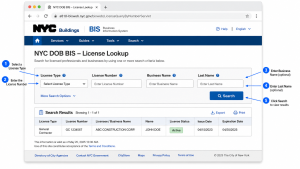
- Go to the Department of Buildings’ Buildings Information System (BIS) license lookup, accessible directly through nyc.gov.
- Search by the plumber’s name, business name, or license number. Even a partial name will return results.
- Select “Master Plumber” as the license type and click search.
- Review the results to confirm the license is currently active. In most cases, this also shows whether the insurance on file is current.
One Detail Most Homeowners Miss
The license belongs to an individual person, not a company.
- A plumbing business can have a licensed Master Plumber as its qualifying individual while sending other, unlicensed workers to actually perform the job.
- This is only acceptable if that Master Plumber is genuinely supervising the work.
- If you want to be thorough, ask which specific licensed individual is responsible for your job and confirm that name matches the BIS record.
Why this matters beyond following the rules: if unpermitted plumbing work causes damage later, or if you try to sell your home and an inspector finds work that was never properly permitted, you are the one left dealing with it, not the plumber who did the work off the books. A properly licensed, local plumbing and drain service will never hesitate to share this information upfront, since it is public record anyway.
Step 2: Get Real Proof of Insurance, Not Just a Verbal Yes
Every legitimate Staten Island plumbing business is required to carry General Liability insurance and Workers’ Compensation insurance as a condition of holding its DOB license. Asking “are you insured?” and accepting a spoken yes is not verification. You want a document in hand.
What to Ask For
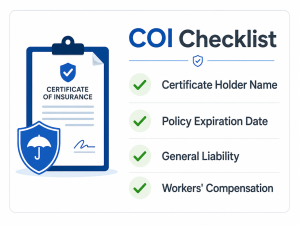
- A Certificate of Insurance (COI) that lists you, the homeowner, as the certificate holder.
- Confirmation of the policy’s expiration date, so you know it will still be valid on the day the work is scheduled.
- The name and phone number of the insurance broker or agency listed on the document.
The Two Policies That Matter Most
- General Liability insurance covers property damage, such as a burst pipe the plumber caused, a flooded floor, or drywall that gets cut into and needs repair.
- Workers’ Compensation insurance covers injury to the worker while on your property. Without it, if someone gets hurt doing plumbing work at your house, the homeowner can end up financially exposed for medical costs.
The Five-Minute Step Most People Skip
Call the insurance broker or agency listed on the COI directly and confirm the policy is still active. This single phone call catches more fake or expired documentation than anything else in this entire process, and a legitimate company will never be bothered by you taking it.
Step 3: Check Reputation Where Staten Islanders Actually Talk About Plumbers
Yelp and Google reviews are not useless, but they are also the easiest reviews to influence, and they are not where most Staten Island homeowners actually go to ask for recommendations. A few sources tend to surface more honest, current information.
- Staten Island-specific Facebook groups. Neighborhood and borough-wide homeowner groups tend to have real, recent threads where people name plumbers they have actually used, both good and bad.
- Because it is tied to verified addresses, it skews more toward real neighbors than anonymous internet reviewers.
- r/statenisland on Reddit. Search the subreddit before posting a new question. There are recurring threads where residents recommend plumbers based on direct experience, and the same handful of names tends to come up repeatedly, which is a stronger signal than a five-star rating with no context.
- Google Business Profile. Sort by “most recent” instead of relying only on the overall star rating, and pay attention to whether the business responds to negative reviews.
What to Look for Once You’re Reading Reviews
- Recent reviews (within the last six to twelve months), not just a large total count.
- Specific details about the work performed, not vague praise like “great service.”
- How the business responds to a negative review. A thoughtful, professional response is a better sign than a perfect five-star record with zero criticism, which can sometimes indicate review-gating.
- Mentions of punctuality, clear pricing, and clean work, which tend to be the most common complaints when they go wrong.
If a name comes up organically across two or three of these sources without you searching for it directly, that is a far stronger signal than a curated list on a company’s own website. A locally owned Staten Island company with a track record across several of these platforms, rather than a national chain dispatching a rotating crew, is usually the safer bet if you need follow-up work down the road. You can see this kind of pattern reflected in the reviews and history of established local companies that have served the same neighborhoods for years.
Step 4: Compare Quotes That Are Actually Comparable
“Get two to three quotes” is standard advice, but it only works if you are comparing the same thing. Two quotes for “$400” mean very different things if one is a flat rate covering parts and labor, and the other is an hourly rate before materials are added.
Four Questions to Ask Every Plumber Before Comparing Prices
- Is this hourly, or a flat rate for the whole job?
- Are parts marked up, and if so, by roughly how much?
- Is there a trip or diagnostic fee, and is it waived if you move forward with the repair?
- What is the warranty on labor, and separately, on parts?
What Plumbing Work Actually Costs in Staten Island Right Now
Pricing in Staten Island tends to run somewhat below Manhattan and Brooklyn rates, largely because of lower travel time, easier parking, and lower overall demand. It is still New York City pricing, so expect more than you would pay in most of the country.
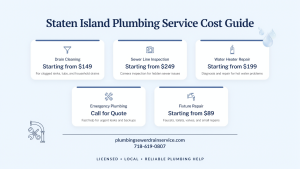
| Job Type | Typical Price Range | What Moves the Price |
| Standard service call or minor repair | $200 – $350 | Time of day, whether it falls on a weekend or after hours |
| Drain clog or snaking | $150 – $400 | Depth of the clog, whether a camera inspection is needed |
| Water heater replacement | $1,000 – $2,500+ | Tank versus tankless, permit requirements, accessibility |
| Sewer line camera inspection | $250 – $600 | Line length, accessibility, whether it is a standalone visit |
| Emergency or after-hours call | Add $100 – $250+ on top of standard rates | Time of night, holiday surcharge, urgency |
Most licensed New York City plumbers charge between $150 and $250 an hour, with total job costs on standard calls typically falling between $200 and $530. Staten Island tends to sit toward the lower-to-middle end of that citywide range rather than the top.
A Simple Way to Organize Your Comparison
- Write down each plumber’s hourly or flat rate side by side.
- Note whether the quote includes parts or lists them separately.
- Flag any quote that is dramatically lower than the other two. It is often missing something, such as permit costs or a diagnostic fee that gets added later.
- Ask each plumber the same follow-up questions so the comparison stays fair.
Red Flags That Predict a Bad Experience
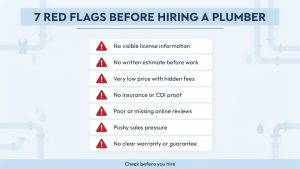
A few patterns show up again and again in complaints from homeowners who ended up regretting who they hired.
- They will not give you a license number when asked directly, or they get vague about it.
- They demand full payment upfront before any work has started, especially on a large job.
- There is no fixed business address, only a cell number and an unmarked van.
- Estimates for anything beyond a small repair are given verbally, with nothing in writing.
- They push “today only” pricing or urgency tactics on a job that is not actually an emergency.
- They cannot clearly answer whether the job requires a permit, or they dismiss the question entirely.
- They are noticeably reluctant to provide a Certificate of Insurance, or the document they send does not list your address.
None of these alone is automatically disqualifying. Plenty of small, legitimate operations run lean and do not have a storefront. But two or three of these together on the same job is a genuine warning sign worth walking away from.
A Real Staten Island Example
A homeowner in the Great Kills area had a slow-draining basement sink and called the first plumber who showed up in a Google search, without checking the license.
What happened:
- The plumber diagnosed it as a simple clog, charged $180, and cleared the visible blockage.
- Three weeks later, the same drain backed up again, worse this time, flooding part of the basement.
- A second, licensed plumber found the real problem: a partially collapsed section of clay sewer pipe further down the line, something that needed a camera inspection to catch and that the first plumber either missed or lacked the equipment to check for.
- The fix required excavation and a permitted repair, running close to $4,500.
- Because the first job was never permitted or documented, the homeowner had no paper trail to fall back on when sorting out what had actually been done the first time.
The lesson: this is not necessarily a story about dishonesty. It is a story about an unverified, undocumented $180 fix on a problem that needed a proper diagnostic, which ended up costing roughly 25 times more than it should have. A main sewer line camera inspection up front, standard practice for a plumber who does this kind of work regularly, would have caught the real issue the first time.
Emergency vs. Non-Emergency: The Rules Change
The full vetting process above works well when you have a day or two to make a decision. It falls apart when your basement is actively flooding at 11 p.m.
For Genuine Emergencies
Active flooding, a gas smell, or no heat in freezing weather all qualify. Use this compressed version instead:
- Pull up the DOB BIS license lookup on your phone while you are still on the call with them.
- Ask them to text you a photo of their Certificate of Insurance before they arrive.
- Confirm the address they are dispatching from matches the business name.
A trusted local plumber who offers 24-hour emergency service will already have this documentation ready to send over without hesitation, since it is a routine request for them.
For Anything That Is Not an Active Emergency
A slow drain, a running toilet, or a minor leak that is being contained all fall into this category. Take the time to do the full process:
- Verify the license.
- Request the COI properly.
- Check reviews across more than one platform.
- Get more than one quote.
Rushing a non-urgent job is how most of the regret in this process happens.
Frequently Asked Questions
How do I know if a plumber is reliable in Staten Island, NY?
Check that their Master Plumber license is active on the NYC DOB BIS lookup, confirm current insurance with a Certificate of Insurance, and look for consistent, recent reviews across more than one platform.
How much does a plumber cost in Staten Island?
Most licensed plumbers charge between $150 and $250 per hour, with a typical service call totaling $200 to $530 depending on the job and time of day.
What questions should I ask a plumber before hiring?
Ask for their license number, proof of insurance, whether the estimate is flat-rate or hourly, and whether the job requires a permit.
Is it worth getting multiple quotes from plumbers?
Yes. Two to three itemized quotes help you compare pricing structure, warranty terms, and scope, not just the bottom-line number.
How do I verify a plumber’s license in NYC?
Search the plumber’s name or license number on the NYC Department of Buildings’ BIS license lookup to confirm the license is active.
What is the difference between a licensed and a master plumber in NY?
A Master Plumber has passed both required exams, cleared a background check, and can legally run a business and pull permits. A journeyman can perform plumbing work only under a Master Plumber’s direct supervision.
Do I need a permit for a water heater replacement in Staten Island?
In most cases, yes, since it involves gas or electrical connections and plumbing modifications that must be signed off by a licensed Master Plumber.
What should I do if I find out my plumber isn’t licensed?
Stop the job if it is still in progress, avoid paying the remaining balance, and consult a licensed plumber to review what was done before moving forward.

The Short Version
Before handing your house keys, literally or figuratively, to a plumber in Staten Island, run through this final checklist:
- Look up their license on the DOB’s BIS system.
- Get a Certificate of Insurance naming you as the certificate holder, and confirm it is active with the broker.
- Check Facebook groups, NextDoor, and r/statenisland, not just Yelp.
- Get two to three quotes that are actually comparable, using the same questions for each.
- Know which neighborhood-specific issues apply to your home, such as older pipes, septic systems, or flood-zone requirements, before the plumber even walks in the door.
- Watch for red flags like upfront full payment demands or vague verbal estimates.
- For emergencies, use the compressed verification steps rather than skipping verification entirely.
It takes maybe twenty extra minutes compared to calling the first name that shows up in a search. That is a small trade for avoiding the kind of mistake that costs thousands of dollars to undo. If a clogged drain, sewer backup, or burst pipe is the reason you are reading this in the first place, a fast, well-documented response from a licensed local team is usually what turns a stressful afternoon into a solved problem the same day. If you would rather skip the research and get a fast, honest quote from a team that already meets every standard on this list, that is exactly what a properly vetted local plumber should be able to offer.